Tennis Ball Machine for a Condo or Club: Buy, Rent or Host One?
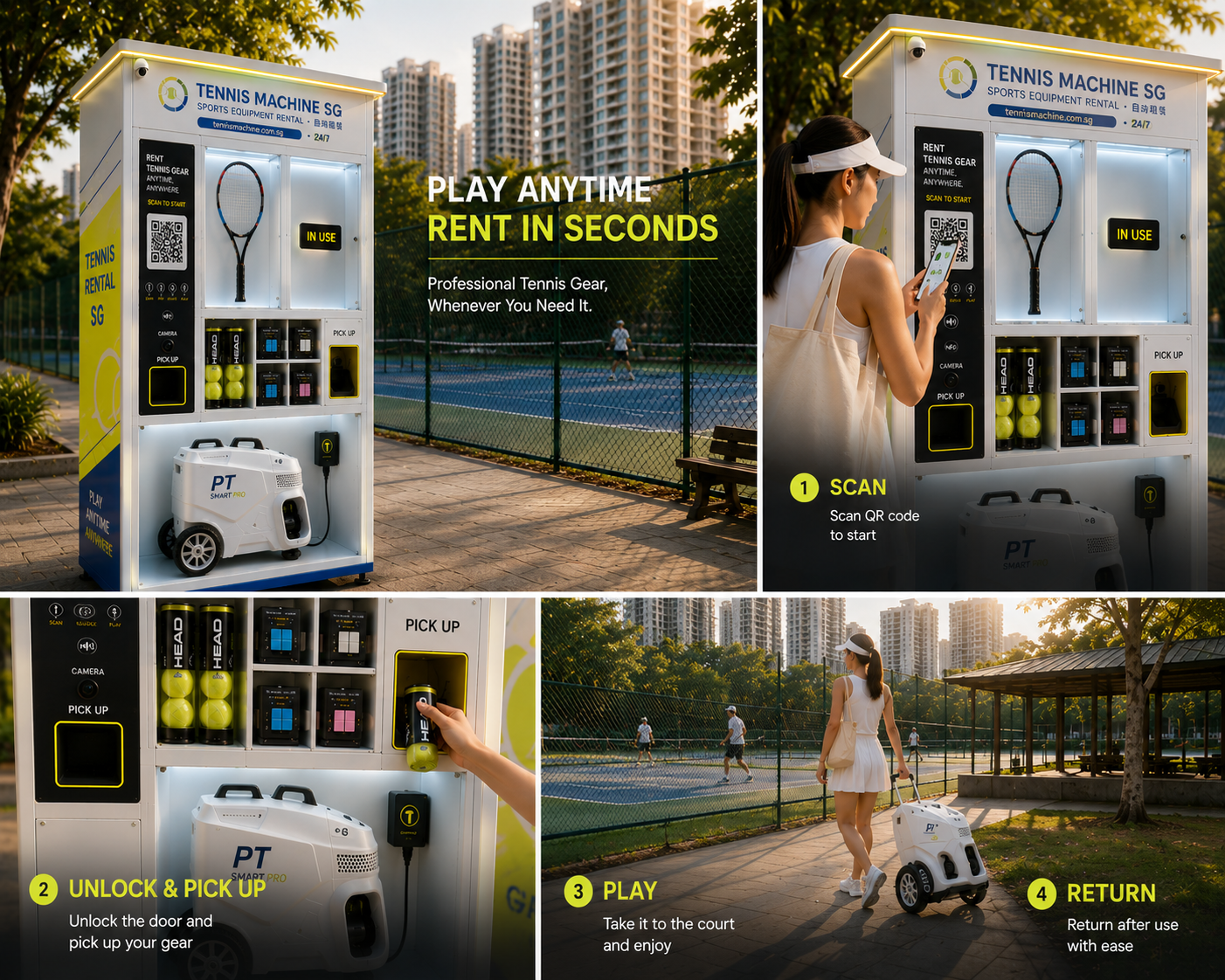
Sooner or later someone at a council or committee meeting asks it: residents keep saying they have nobody to hit with, so why don't we just buy a ball machine? It sounds like a one-off purchase. In practice it is a small facility that someone has to run — and the question is really who that someone should be.
This guide compares the three realistic options for a Singapore condominium or private club: buying a machine, letting residents rent their own, and hosting a self-service locker run by an operator. If you are new to what these machines do, start with the benefits of training with a tennis ball machine.
Quick answer
For most Singapore condominiums and clubs, buying a tennis ball machine creates more work than it saves: a reliable battery model typically costs S$1,200 to S$3,000 or more, and the estate then owns bookings, keys, charging, ball replacement, repairs and liability. Residents renting their own works for keen players but adds nothing to the estate. Hosting a self-service locker such as Tennis Machine SG's Smart Tennis Hub gives residents 24/7 access with no capital outlay, staffing or maintenance, and pays the estate a monthly rental, indicatively from S$60.
Option 1: Buy a ball machine for the estate
Buying works when the estate has a staffed sports desk and an appetite to run it. The purchase is the small part. A reliable battery-powered machine typically costs S$1,200 to S$3,000 or more in Singapore; outdoor courts rarely have power at the baseline, so a battery model is the practical choice. Then come balls, a ball cart, a pick-up tube and somewhere lockable to keep it all. What follows is the part that rarely makes it into the council paper:
- Bookings: someone keeps a booking sheet and settles disputes — or the machine is first-come, and the same three residents have it every weekend.
- Keys and handover: security or the management office signs it out and back in, and chases the resident who forgot.
- Charging: a machine returned flat is useless to the next player, so someone has to plug it in every time.
- Balls: they wear out. Machines need pressureless balls, which last far longer than pressurised ones but still lose their felt and need replacing — see why ball machines need pressureless balls.
- Repairs: feeding wheels, motors and batteries wear. Spare parts and servicing are the estate's problem, and a broken machine sits idle until someone fixes it.
- Liability: the estate becomes the equipment provider. Insurance and by-laws need to cover how residents use it.
Option 2: Let residents rent their own
Renting is the right answer for an individual player and costs the estate nothing — but it adds nothing to the estate either. A keen resident can already rent a professional machine: Tennis Machine SG rents from 24/7 smart lockers at S$35 an hour or S$50 for two hours, and by the day or week via WhatsApp. The catch for a condo is location. A locker is only convenient for the courts near it, so residents of an estate without one rarely make the trip. The facility on the estate's own grounds stays exactly as it was.
Option 3: Host a self-service ball machine locker
Hosting puts the machine beside your own court without the estate running anything. With Tennis Machine SG's Smart Tennis Hub, the operator installs a weather-sealed smart locker holding a professional ball machine — the same kind described on our machine features page — plus 130+ balls, a cart and a ball picker. Residents book, pay and unlock it from their phones; there is no app, no key and nobody on duty.
The estate provides about 90 × 60 cm of floor beside or near the court and one 3-pin socket. The operator funds the hardware, carries the insurance, services the machine, replaces the balls, handles every payment and support message, and pays the management fund a fixed monthly rental — indicatively from S$60 — or a base rental plus a share of the revenue. Court booking stays under the estate's existing rules: a resident still needs a valid court booking to play.
The three options side by side
| Buy a machine | Residents rent | Host a Smart Tennis Hub | |
|---|---|---|---|
| Cost to the estate | S$1,200–S$3,000+ upfront, plus balls, cart and storage | None | None |
| Money to the estate | None — a recurring cost | None | Monthly rental, indicatively from S$60, or a revenue share |
| Bookings & payments | Estate's job | Resident's own arrangement | Operator's app, 24/7 |
| Keys & charging | Estate staff | Not applicable | Locker opens for the booked resident; charges itself |
| Repairs & balls | Estate's cost | Rental company | Operator |
| Liability | Estate, as equipment provider | Rental company and resident | Operator's insurance, plus a waiver and S$200 deposit hold per session |
| On the estate's own court | Yes | Only if a locker is nearby | Yes |
| If it doesn't work out | An idle machine to dispose of | Nothing to undo | Operator removes it and makes good the space |
Eight questions to ask any provider
If your estate or club goes the hosted route, these are the questions that separate a well-run amenity from a cabinet that becomes the managing agent's problem. Ask them of any provider, including us.
- What insurance do you carry, and can the council see the certificate?
- Who handles a resident's complaint at 10pm — and does any of it reach our management office?
- How is damage covered? Look for a deposit hold on every session, not an honour system.
- How does the cabinet know the machine came back? Sensors that check items back in beat a "tap to confirm" button.
- What happens when the internet drops? A cabinet that needs the cloud to open will strand players.
- Who pays the electricity, and how much is it? (For a Smart Tennis Hub: roughly 15–20 kWh a month at maximum usage, covered in the rental.)
- How do we end it? Look for a short notice period and removal at the provider's cost.
- Can we see one running? A live, unattended deployment is worth more than any brochure.
Running today in Jurong
Tennis Machine SG's first smart locker has rented a professional ball machine with nobody on duty since early 2026, a short walk from the courts at ActiveSG Sport Village @ Jurong Town. You can see it, with its live status, before your council decides anything.
How to put it to your council or committee
The smoothest approvals follow the same four steps. First, a ten-minute site walkthrough to agree a corner and a socket. Second, a short written proposal formatted for the council or committee papers, covering placement, terms, insurance and termination. Third, the meeting — where it helps to have the provider present to answer questions. Fourth, a fixed-length pilot with a clear exit, so nobody is asked to commit before seeing real usage figures. Tennis Machine SG starts every placement with a risk-free three-month pilot.
Whether a condo council can approve a licence like this itself, or should table it at a general meeting, depends on the estate's by-laws and the licence terms — your managing agent will know the route. Our page for condominiums and MCSTs sets out what a council is actually being asked to approve, and the page for private clubs covers member pricing and sponsored play. Once a machine is in place, residents can learn the controls from our guide to using a tennis ball machine.
Frequently asked questions
Should a condo buy a tennis ball machine for residents?
Usually not. A reliable battery-powered tennis ball machine typically costs S$1,200 to S$3,000 or more in Singapore, and the estate then has to own bookings, key handovers, charging, ball replacement, repairs and liability. Most condominiums get the amenity with less work by hosting a self-service locker such as Tennis Machine SG's Smart Tennis Hub, which costs the estate nothing and pays the MCST a monthly rental, indicatively from S$60.
How much does a tennis ball machine cost in Singapore?
A reliable battery-powered tennis ball machine typically costs from about S$1,200 to S$3,000 or more in Singapore, before balls, a ball cart and lockable storage. Renting one costs much less per session: Tennis Machine SG rents professional ball machines from 24/7 smart lockers for S$35 an hour or S$50 for two hours, with 130+ balls, a cart and a ball picker included.
What is a Smart Tennis Hub?
A Smart Tennis Hub is a self-service smart locker, installed and run by Tennis Machine SG beside a condominium, club or venue's tennis courts, that holds a professional tennis ball machine, 130+ pressureless balls, a cart and a ball picker. Players book, pay and unlock it from their phones; the host provides about 90 by 60 cm of space and a 3-pin socket, and Tennis Machine SG handles payments, insurance, servicing and support.
Who is liable if a resident is injured using an estate-owned ball machine?
When an estate or club buys and lends out its own ball machine, it takes on the role of equipment provider, so its insurance and by-laws need to cover how the machine is used. With a hosted Smart Tennis Hub, Tennis Machine SG carries public liability and equipment insurance, every user accepts its Terms of Service and Liability Waiver before the cabinet opens, and each session carries a refundable S$200 deposit hold. Estates should still confirm the arrangement with their own insurer and managing agent.
Can residents simply rent a ball machine themselves instead?
Yes. Keen players can rent a machine on their own — Tennis Machine SG rents by the hour from its smart lockers, and by the day or week via WhatsApp. That works for individuals, but it adds nothing to the estate's facilities and earns the estate nothing; hosting a Smart Tennis Hub puts the machine beside the estate's own court for every resident.
Related Reading
Put a ball machine beside your own court
No capital outlay, no staffing, a risk-free three-month pilot — and for estates, a monthly rental.