Tennis Footwork Drills with a Ball Machine
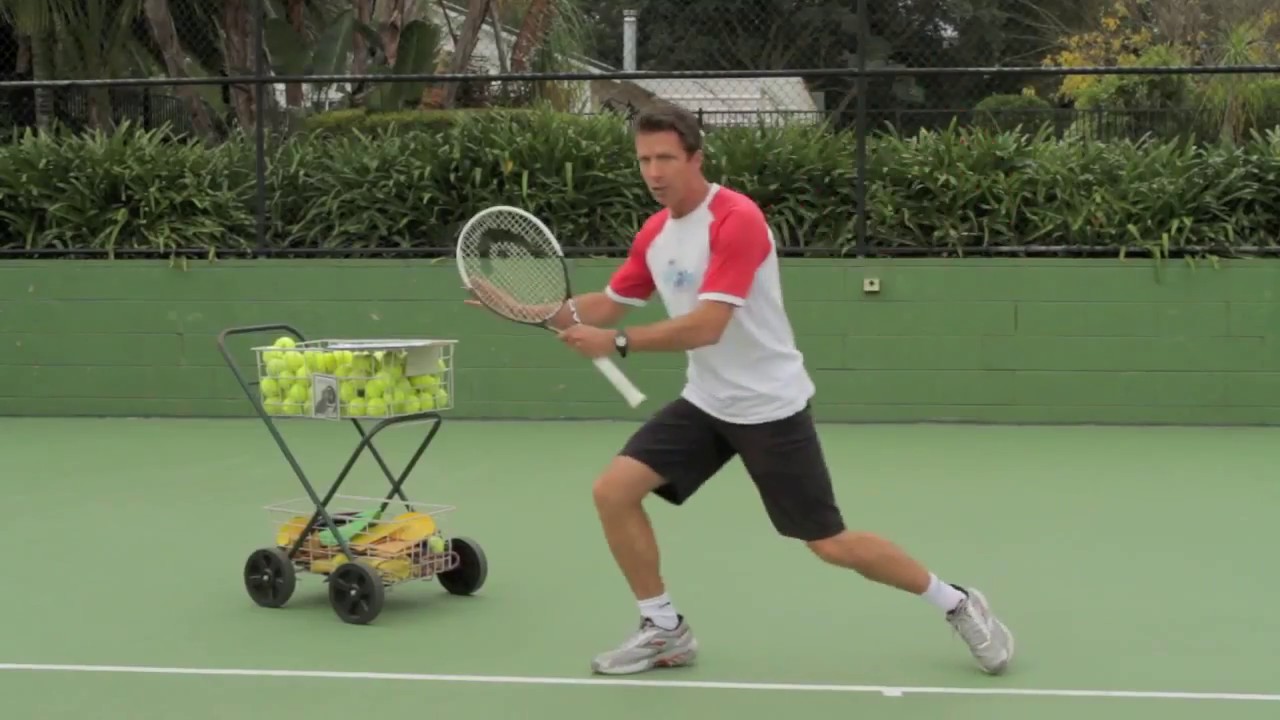
When a coach tells you your forehand is breaking down, roughly four times out of five the forehand is fine and the feet arrived late. You cannot hit a balanced ball from an unbalanced position, no matter how good the swing is. The problem is that footwork is almost impossible to isolate in normal practice, because a hitting partner's ball is never the same twice — you can always blame the feed.
A tennis ball machine removes that excuse. The feed is identical every single time, so if your contact point moves, your feet moved it. This guide covers six footwork drills, the machine settings for each, and how to build a movement block into a session. If you are new to machine practice, start with our beginner's guide to using a tennis ball machine.
Quick answer
To train tennis footwork with a ball machine, use a slow feed of 5–7 seconds so you can complete a full recovery between balls, moderate speed of 45–60%, and wide oscillation to force lateral movement. Judge each rep on where your feet finished, not on where the ball went. Two 15–20 minute footwork blocks per week, run while you are fresh, are enough to change your movement pattern within a month.
The Four Phases of Every Tennis Movement
Every shot you hit contains the same four movement phases. Naming them matters, because it tells you which one you are actually failing at:
- Split-step: the small hop that lands as your opponent strikes, converting standing into ready-to-move.
- First move: the initial push-off in the direction of the ball, driven by the outside leg.
- Adjustment steps: the short steps that fine-tune your distance from the ball in the last metre.
- Recovery: the movement back toward the middle after contact — the phase almost everyone skips.
Most club players are competent at the first move and poor at adjustment and recovery. That is why they hit a good first ball and a bad second one. Each drill below targets a specific phase.
Drill 1: Split-Step Timing
Set a slow feed with oscillation off. Treat the ball leaving the machine as the opponent's contact. Your split-step must land at that exact moment — landing early leaves you flat-footed again by the time you need to move, and landing late means you never loaded at all.
- 4 × 12 balls with a 6-second feed.
- Cue: "land as it launches."
- Ignore shot quality completely for these sets. Timing is the only score.
Drill 2: Wide-Ball Loading
Turn on wide oscillation and let the machine pull you off the court. The point is not to reach the ball — it is to arrive with your outside foot planted and your weight loaded over it, so you can push back rather than fall away.
- 3 × 14 balls, wide oscillation, slow feed.
- Cue: "plant the outside foot, then hit."
- If you are still moving sideways at contact, the machine speed is too high for your current range. Drop it.
Drill 3: Recovery Steps
This is the highest-value footwork drill in the guide and the one nobody runs. After every ball, you must return to a marked recovery position before the next feed arrives. Put a cone or a water bottle on the centre mark and touch it with your eyes, not your hands.
- 4 × 10 balls, wide oscillation, 7-second feed.
- Cue: "hit, then get home."
- Use side-shuffle steps facing the net, never a slow walk or a turn-and-jog.
Why recovery is worth more than reach
A player who recovers two metres faster does not need to be two metres quicker. Recovery is the cheapest speed you will ever buy, because it costs conditioning rather than genetics. It is also the first thing to disappear when you get tired, which is exactly why it deserves a dedicated block rather than a mention at the end of a session.
Drill 4: Short-Ball Sprint and Transition
Lower elevation and reduce speed so the feed lands short. Start behind the baseline, sprint forward, hit an approach, and continue moving to a net position. This is the movement chain that links baseline play to the net game covered in our volley and net drills guide.
- 3 × 8 approaches with full rest between sets.
- Cue: "hit through the ball while moving forward, never while stopping."
- Finish every rep with a split-step at the service line, not a stop.
Drill 5: Deep-Ball Retreat
Raise elevation so the feed lands within a metre of the baseline. You have to move backwards under control and still hit a neutral, deep reply. Retreating footwork is the least-practised movement in club tennis and the reason so many players get pushed further and further behind the baseline.
- 3 × 10 balls, high elevation, slow feed.
- Cue: "turn and crossover, never backpedal."
- Recover forward to the baseline after each ball — retreating without returning is how you lose court position permanently.
Drill 6: Random Movement Under Fatigue
Put this at the end. Wide random oscillation, medium feed, and run until your form starts to go — then stop. The purpose is to find the exact point where your footwork collapses, because that point is your real match fitness ceiling.
- 2 × 20 balls, wide random oscillation, 4-second feed.
- Cue: "same feet at ball 20 as at ball 1."
- Stop the set at the first ball where you stop recovering. Do not push through it — you would only be practising bad movement.
Recommended Settings Summary
| Drill | Speed | Elevation | Feed | Oscillation |
|---|---|---|---|---|
| Split-step timing | 45-55% | Medium | Slow (6s) | Off |
| Wide-ball loading | 50-60% | Medium | Slow (6s) | Wide |
| Recovery steps | 45-55% | Medium | Slow (7s) | Wide |
| Short-ball sprint | 35-45% | Low | Slow (7s) | Off |
| Deep-ball retreat | 55-65% | High | Slow (6s) | Off |
| Random under fatigue | 50-60% | Medium | Medium (4s) | Wide random |
Three Footwork Faults the Machine Will Expose
- Walking to the ball. Against an identical feed you should arrive identically. If you are early on ball 3 and late on ball 8, you are strolling on the easy ones.
- No recovery. Watch where you stand when the next ball launches. If it is where you finished the last shot, you have no recovery habit at all.
- Reaching instead of stepping. If your arm extends before your last step lands, you have stopped moving too early. This is the single most common cause of the mistakes in our guide to fixing common forehand mistakes.
Building Footwork Into a Training Week
Put footwork first in the session, not last. Movement is a skill before it is a fitness quality, and skills are learned fresh. Fifteen to twenty minutes at the start of two sessions a week is plenty — pair it with the stroke blocks in our 4-week ball machine training plan, and use our guide to the best Singapore courts for machine practice to find a court with enough run-off space behind the baseline. Every rental from Tennis Machine SG includes the machine, 130+ pressureless balls, a transport cart and a ball picker — see rental pricing and the full machine features.
Frequently Asked Questions
Is a tennis ball machine good for footwork training?
Yes, and it is better than a hitting partner for this purpose. A machine feeds an identical ball to the same place every time, so any variation in where you end up is caused by your movement, not by the feed. That makes footwork errors measurable in a way that live hitting does not, because a partner's inconsistent ball hides your inconsistent feet.
What machine settings should I use for footwork drills?
Use a slower feed than you would for stroke practice, typically 5-7 seconds between balls, so you have time to complete a full recovery before the next feed. Keep speed moderate at 45-60 percent and use wide oscillation to force lateral movement. Speed up the feed only after your recovery step is automatic.
How do I practise the split-step alone?
Set a slow feed and treat the moment the ball leaves the machine as the moment the opponent strikes it. Your split-step should land at that instant, not before and not after. Ignore the quality of your shot entirely for a few sets and judge yourself only on split-step timing.
How often should footwork be trained?
Movement quality degrades with fatigue, so short and frequent beats long and occasional. Two 15-20 minute footwork blocks per week, placed at the start of a session while you are fresh, produce better results than one long session at the end when your legs are already gone.
Where can I rent a ball machine for footwork training in Singapore?
Tennis Machine SG rents professional-grade tennis ball machines from 24/7 self-service smart lockers, currently at 166 Yung Kuang Road, a short walk from the courts at ActiveSG Sport Village @ Jurong Town. Rentals are S$35 for one hour and S$50 for two hours, and can be booked up to 14 days in advance or unlocked on the spot by scanning the locker QR code.
Related Reading
Train the Feet, Not Just the Swing
Rent a tennis ball machine in Singapore and give your movement the repetitions it has never had.