Off-Court Conditioning for Tennis Players in Singapore
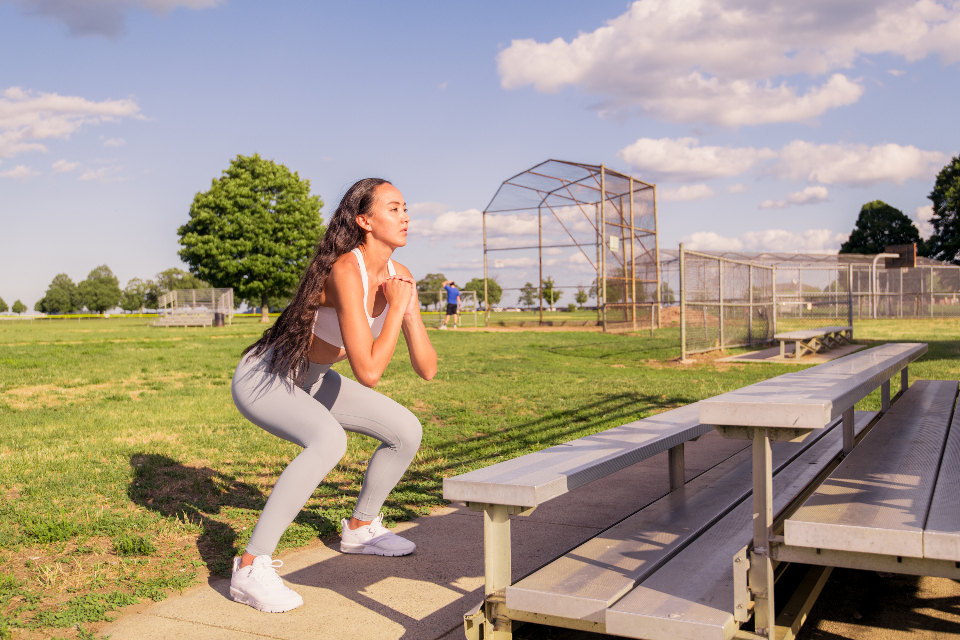
There is a ceiling on what stroke practice can do for you, and most club players hit it without realising. You can groove a technically sound forehand and still hit a poor one in a match, because the shot was played off a leg that could not brake in time. When your third set falls apart, the problem is almost never that your technique degraded — it is that your legs stopped arriving.
Off-court conditioning is what removes that ceiling, and it is the part of training recreational players in Singapore skip most consistently. This guide covers the four physical qualities tennis actually demands, a weekly template that fits around two court sessions, equipment-free options, and how to handle the heat and humidity that make every prescription written for a temperate climate slightly wrong here. For the on-court half of the same problem, see our ball machine footwork drills.
Quick answer
Tennis conditioning comes down to four qualities: lower-body power, deceleration strength, rotational trunk strength, and a repeat-sprint aerobic base. Two 30-minute off-court sessions a week alongside two court sessions is enough for a recreational player, and none of it requires a gym — split squats, lateral bounds, medicine-ball throws and stair sprints cover all four. In Singapore, train outdoors before 9am or after 6pm, and take longer rests than a temperate-climate programme prescribes, because 70–90% humidity blocks the sweat evaporation your body relies on to cool itself.
What Tennis Actually Demands
Tennis is a repeat-sprint sport, not an endurance sport. A club singles point typically lasts 4–10 seconds, followed by roughly 20 seconds of rest, repeated for an hour or more. That structure has specific consequences: you need to produce high force very quickly, absorb it again immediately, and recover enough between efforts to do it all again about four hundred times. Long steady jogging trains almost none of that.
The demand breaks into four trainable qualities:
- Lower-body power: the ability to push off hard from a standing start. This is your first step to a wide ball.
- Deceleration strength: the ability to absorb force and stop under control. A tennis point is mostly braking, and this is the quality club players neglect most.
- Rotational trunk strength: the ability to transfer force from the legs through the trunk into the racquet, and to resist unwanted rotation while you do it.
- Repeat-sprint aerobic base: the ability to recover between points. This is what determines whether the third set looks like the first.
Deceleration Is the One You Are Missing
Deceleration strength — the capacity to absorb force eccentrically while a muscle lengthens — is the single most underdeveloped quality in recreational tennis players, and it is what separates a controlled wide forehand from a lunge. Every time you sprint to a wide ball, the last two steps are a braking action, and the load through the outside leg in that moment is several times body weight.
You train it by landing, not by jumping. Three exercises cover it:
- Lateral bound and stick: jump sideways onto one leg and hold the landing completely still for three seconds. Three sets of five per side. If you wobble, you have found your weak side.
- Slow eccentric split squat: lower over four seconds, stand up normally. Three sets of eight per leg.
- Depth drop: step off a low step or kerb and absorb the landing softly on both feet, knees tracking over toes. Three sets of six, and keep the height low — this is a skill exercise, not a test of courage.

A Weekly Template Around Two Court Sessions
Concentrate hard days rather than spreading moderate fatigue across the week. Put power and sprint work on the same day as a court session, after hitting rather than before, and keep the day before a match genuinely easy.
| Day | Session | Focus |
|---|---|---|
| Monday | Off-court, 30 min | Lower-body strength and deceleration |
| Tuesday | Ball machine, 60 min | Stroke or pattern work |
| Wednesday | Easy aerobic, 25 min | Conversational-pace jog, swim or cycle |
| Thursday | Off-court, 30 min | Power, rotation and trunk |
| Friday | Rest or mobility | Hips, ankles, thoracic spine |
| Saturday | Match or ball machine, 90 min | Play, or a movement-heavy machine session |
| Sunday | Rest | Full rest |
The Two Off-Court Sessions in Full
Neither session needs equipment beyond a step, a wall and something with a bit of weight to throw. Both take about thirty minutes including warm-up.
Session A — strength and deceleration. Five minutes of easy movement and leg swings, then: split squats 3 × 8 per leg with a slow four-second lowering; lateral bound and stick 3 × 5 per side; single-leg calf raises 3 × 12 per side; side plank 3 × 30 seconds per side; dead bug 3 × 10 per side.
Session B — power and rotation. Same warm-up, then: broad jumps 4 × 3 with a full stop between reps; step-ups onto a knee-high step 3 × 8 per leg; rotational medicine-ball throws into a wall 4 × 6 per side, or a heavy bag if no wall is available; Pallof press or a band anti-rotation hold 3 × 20 seconds per side; stair sprints 6 × 10 seconds with 50 seconds walking recovery.
Where to train for free in Singapore
Nearly every HDB estate has an outdoor fitness corner with pull-up bars, steps and parallel bars — enough for both sessions above. ActiveSG gyms across the island charge a low entry fee if you want dumbbells and a proper medicine ball, and most connector park routes give you a shaded stretch of stairs for sprints.
Training in Singapore Heat and Humidity
Singapore's constraint is humidity, not temperature. At 70–90% relative humidity, sweat does not evaporate efficiently, and evaporation is the mechanism your body uses to shed heat. The practical effect is that heat accumulates faster than the air temperature alone suggests, and any given workload feels harder than the same session in a dry climate.
Three adjustments follow. Train outdoors before 9am or after 6pm rather than in the afternoon. Extend the rest intervals in any programme written elsewhere by roughly half — a written 60-second rest between sprints should usually be 90 here. And move interval work indoors, into an air-conditioned gym or a sheltered void deck, when the afternoon Heat Stress Advisory is high. Our guide to training in Singapore heat, humidity and rain goes into hydration and monsoon planning in detail.
This is where 24/7 access changes the calculation. Our smart lockers unlock at any hour, so a 6:30am court session before work is as available as an evening one, and the two best training windows in the Singapore day both become usable. You can see current locker sites and machine availability on the services page.
Turning a Machine Session Into Conditioning
A ball machine doubles as a conditioning tool when you set wide oscillation and a fast feed of 3–4 seconds. That removes the recovery time a normal rally gives you and turns the block into continuous lateral movement with a racquet in your hand — closer to the demands of a long point than any shuttle run. Ten minutes of that is a hard interval, and it is more specific to tennis than anything you can do on a treadmill.
It does not replace strength work, because a machine cannot load the muscles that absorb force the way a slow eccentric split squat does. Treat it as the repeat-sprint component, and keep Sessions A and B for everything else. Our 4-week training plan shows how conditioning blocks and technical blocks fit into the same hour.
Start With Two Sessions a Week
Two thirty-minute sessions a week is enough. It is also, crucially, sustainable — the ambitious five-day plan you abandon in a fortnight is worth less than the modest one you keep doing in March. Add the on-court work around it: an hour costs S$35 and two hours S$50, machines are available 24/7 from our court-side lockers, and slots can be booked up to 14 days ahead. See the full rental pricing, and if you are managing a sore arm alongside this, read our guide to practising with tennis elbow first.
Frequently Asked Questions
What off-court training helps tennis the most?
The four off-court qualities that transfer most directly to tennis are lower-body power, deceleration strength, rotational trunk strength, and a repeat-sprint aerobic base. Deceleration is the one club players neglect and the one that decides whether a wide ball is a controlled shot or a lunge, because a tennis point is mostly braking. Two 30-minute off-court sessions a week alongside two on-court sessions is enough to change how a recreational player moves within about six weeks.
Do I need a gym to do tennis conditioning?
No gym is required for tennis conditioning. Split squats, step-ups, single-leg hops, lateral bounds, planks and medicine-ball throws cover lower-body power, deceleration and rotational strength using only body weight, a set of stairs and a wall. Singapore has free outdoor fitness corners in most HDB estates and ActiveSG gyms with low entry fees, so equipment is rarely the real barrier.
How should tennis conditioning be scheduled around court sessions?
Put power and sprint work on the same day as a court session, after hitting rather than before, and keep the day before a match or a hard practice easy. This concentrates hard days and leaves genuinely easy days for recovery, which produces better results than spreading moderate fatigue across every day of the week. A workable pattern for a recreational player is two court sessions, two strength sessions and one easy aerobic session per week.
How does Singapore heat affect off-court training?
Singapore's year-round humidity of roughly 70 to 90 percent blocks sweat evaporation, so body heat accumulates faster than in a dry climate and perceived effort rises for the same workload. Train outdoors before 9am or after 6pm, take longer rests between hard efforts than a written programme suggests, and move interval work indoors when the afternoon Heat Stress Advisory is high. Tennis Machine SG's smart lockers are available 24 hours a day, which makes early-morning and late-evening court sessions practical to pair with off-court work.
Can a ball machine session count as conditioning?
A ball machine session can be turned into conditioning by setting wide oscillation and a fast feed rate of 3 to 4 seconds, which produces continuous lateral movement rather than a rally with recovery time built in. Tennis Machine SG machines feed 130 or more pressureless balls and oscillate across the full court width, so a 10-minute block at that setting is a demanding interval. It does not replace strength work, because a machine cannot load the muscles that absorb force, but it covers the repeat-sprint side well.
Related Reading
Put the Fitness Work Somewhere It Shows
Stronger legs are worth having on court. Book a machine before work or after dinner — the lockers are open 24/7.